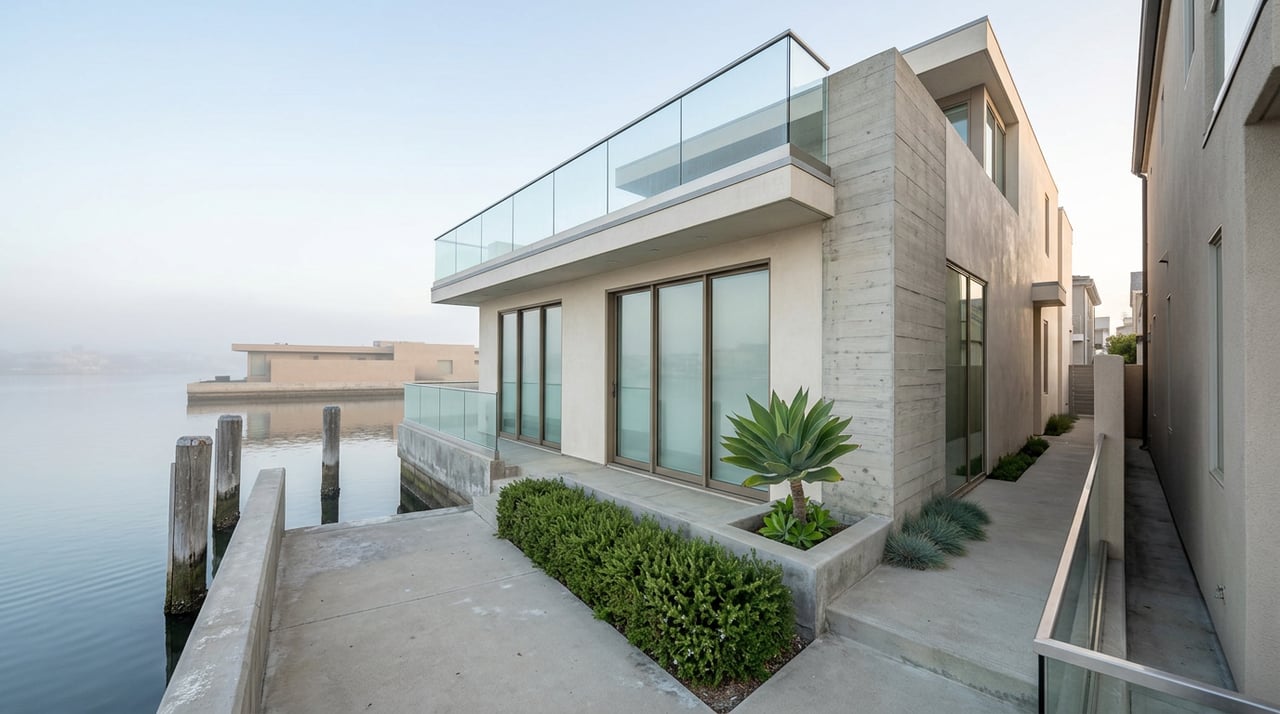
One Road In: What a Dead End Still Shapes on Silver Strand
September 24, 2026
September 24, 2026
Victoria Avenue does not lead anywhere else. Drive it far enough south from Highway 101 and it simply stops, at the sand, with Port Hueneme Naval Base on one shoulder and the mouth of Channel Islands Harbor on the other. That single entrance and exit is the whole way in and out of Silver Strand Beach and Hollywood By The Sea, and it has been that way since the tract went in nearly a century ago.
Most write-ups treat this as a footnote, a quirk of geography that makes for a nice quiet beach. It's more than that. The same isolation that kept Silver Strand hard to stumble into by accident is the reason a hardcore punk movement was born here in the first place, and it's the same reason the neighborhood still runs on one bar, one food truck and a market that shows up once a month instead of a strip of chain storefronts. The dead end isn't incidental to the character of this place. It built it.
Before the isolation produced music, it produced movies. In the early 1900s, when a film crew needed little more than a camera and daylight, Oxnard's sweeping dunes at Leon Lehmann's ranch, the largest in Ventura County at the time, became a standing backdrop for silent pictures. Theda Bara's Cleopatra was shot there in 1917. Douglas Fairbanks's Bound in Morocco followed a year later, and Rudolph Valentino's The Sheik used the same dunes in 1921.
Developers platted a tract and named it Silver Strand, a nod to the silver screen productions that had put the dunes on the map. In 1926, Lehmann sold his 80-acre ranch to developer Fred J. Cutting, who leveled what remained of the dunes and subdivided the land into 100 lots under the name Hollywood-by-the-Sea.
Jeffrey Maulhardt, a fifth-generation descendant of two of Oxnard's founding families, has traced the tradeoff directly: building beach-side housing meant grading away the dunes that made the desert scenes possible, and the film crews had no reason to stay once the backdrop was gone.
The name stayed anyway, on every street sign and property listing since, which is why a neighborhood with no working studio ties still carries a name lifted straight from the industry that briefly used it as a backlot.
Isolation cuts both ways. A place that's hard to reach is also hard to police and easy to overlook, which is part of why Silver Strand and neighboring Port Hueneme became the birthplace of Nardcore, the hardcore punk and skate scene that fused "hardcore" with "Oxnard" into one word. Bands including Dr. Know, Ill Repute and Aggression came out of this stretch of coast, and the sound is not treated as ancient history here. The Strandwich, the food truck that anchors the beach's food scene today, proudly displays Nardcore memorabilia alongside its sandwich board.
That's the throughline worth sitting with. A neighborhood that could only be reached by one road built its own scene because nobody was driving through by accident, and it still runs that way. There's no through traffic, so there's no reason for anything here to exist for anyone but the people who already live down that one road.
Silver Strand has never had room for a big-box anything, and that hasn't changed; its community life still centers on small, local gatherings.
Once a month, the parking area near The Strand Bar & Grill turns into a pop-up market: around 20 vendors, raffle prizes, face painting, snow cones, and the bar itself opening for a few hours in the middle of it. It isn't a tourist draw. It's the kind of gathering that only makes sense in a neighborhood small enough that everyone already knows when it's happening.
The other defining fact about Silver Strand is that it's genuinely narrow, a single strip of land with the ocean on one side and the harbor on the other, sometimes only a street's width apart. That geography shows up in the surf, which breaks into three distinct peaks along the same mile of sand:
On the harbor side, the same narrow stretch turns calm enough for kayaking and paddleboarding, so a resident can walk from a surf session to flat water in the time it takes to cross a street. Toward the beach's southern point, near where it meets the Naval Base fence line, murals painted by local artists including Evan Mendel, Jess Mavros and Gina Lu Sloatman turn a stretch of government wall into a walking gallery, one more thing that exists here because a small group of people decided it should.
County rules keep the beach itself simple: dogs are welcome on leash before 9 a.m. and after 5 p.m., and a dozen or so first-come bonfire pits line the sand for anyone who wants one, with firewood sold nearby.
Fall on Silver Strand shows up first in the water. The Bowl starts firing the way locals wait for it to, and out past the harbor mouth, boats from Island Packers, Channel Islands Whale Watching and Doug's Channel Islands Tours are still running the humpback, blue and fin whale trips that run spring through fall, before the operators shift over to gray whale migration season in late December. The Channel Islands Maritime Museum marks that turn each year with its Celebration of the Whales festival, now in its 27th year, a harbor tradition that outlasts most of what gets built around it.
None of this changes because a real estate listing goes up or a new resident moves in. It's already running, on its own clock, down a road that only goes one place. That's the part worth knowing if you already live here: the neighborhood isn't performing its character for visitors. The dead end never gave it a reason to.
If you're curious what any of this means for property values along the Strand, or you're weighing a move within Ventura County's coastline, Ariel Palmieri and the Palmieri Stein Group know this stretch of sand road by road. Start your coastal home journey whenever you're ready to talk specifics.
This article is general information, not legal, tax or financial advice. Consult a qualified professional about your situation.
Stay up to date on the latest real estate trends.


Your real estate journey deserves a dedicated partner. At the Palmieri Stein Group, we deliver world-class service with a focus on personalized guidance, data-driven decisions, and luxury marketing.