Explore Carpinteria Homes and Neighborhood Options
May 28, 2026
May 28, 2026
Wondering how one small beach town can offer such different home-buying experiences? In Carpinteria, a few miles can change everything, from direct sand access near the shore to walkable village living around Linden Avenue to more elevated homes along the foothills. If you are trying to decide where your lifestyle and budget fit best, this guide will help you compare the main options and understand the tradeoffs. Let’s dive in.
Carpinteria is compact, but it is not one-note. The city covers about 2.6 square miles of land, with elevation ranging from sea level to about 700 feet, which helps explain why housing choices can feel so different from one area to the next.
The city is also entirely within California’s coastal zone. That means local coastal policies and the city’s Local Coastal Program apply across town, which matters when you are looking at location, property use, and long-term planning.
From a market perspective, Carpinteria remains a thin coastal market where pricing can move quickly. Realtor.com’s April 2026 snapshot shows 68 homes for sale, a median listing price of $1.489 million, 51 median days on market, and a 98% sale-to-list ratio, while Redfin’s March 2026 snapshot puts the median sale price at $1.647 million with 29 median days on market.
For many buyers, the dream starts at the water. Carpinteria’s Beach Neighborhood is defined by the city as the area bounded by the railroad tracks, Linden Avenue and Carpinteria State Beach Park to the east, Carpinteria City Beach to the south, and the Carpinteria Salt Marsh Reserve to the west.
This area includes single-family homes, multi-unit apartment and condominium buildings, and Silver Sands Mobile Home Park. The city describes the neighborhood character as small-scale Craftsman and bungalow, which gives the area a classic coastal feel.
The biggest appeal is simple: immediate access to the coast. Carpinteria City Beach sits at the foot of Linden Avenue, Carpinteria State Beach is at the foot of Palm Avenue, and Rincon Beach Park is at the foot of Bates Road.
If your ideal day includes early beach walks, easy surf access, or sunset views close to home, this part of town can deliver a lifestyle that feels hard to match elsewhere. For some buyers, that proximity is the whole point of owning in Carpinteria.
The same location that creates the lifestyle appeal also creates risk considerations. The city’s sea-level-rise studies and living shoreline work identify the Beach Neighborhood and downtown beachfront zone as vulnerable to coastal flooding, erosion, wave attack, and tidal inundation.
The city is planning a nature-based dune system to help protect the beach neighborhood and nearby downtown resources while maintaining a wide sandy beach. If you are exploring beachfront or beach-adjacent homes, it is wise to understand how these location-specific factors may shape your decision.
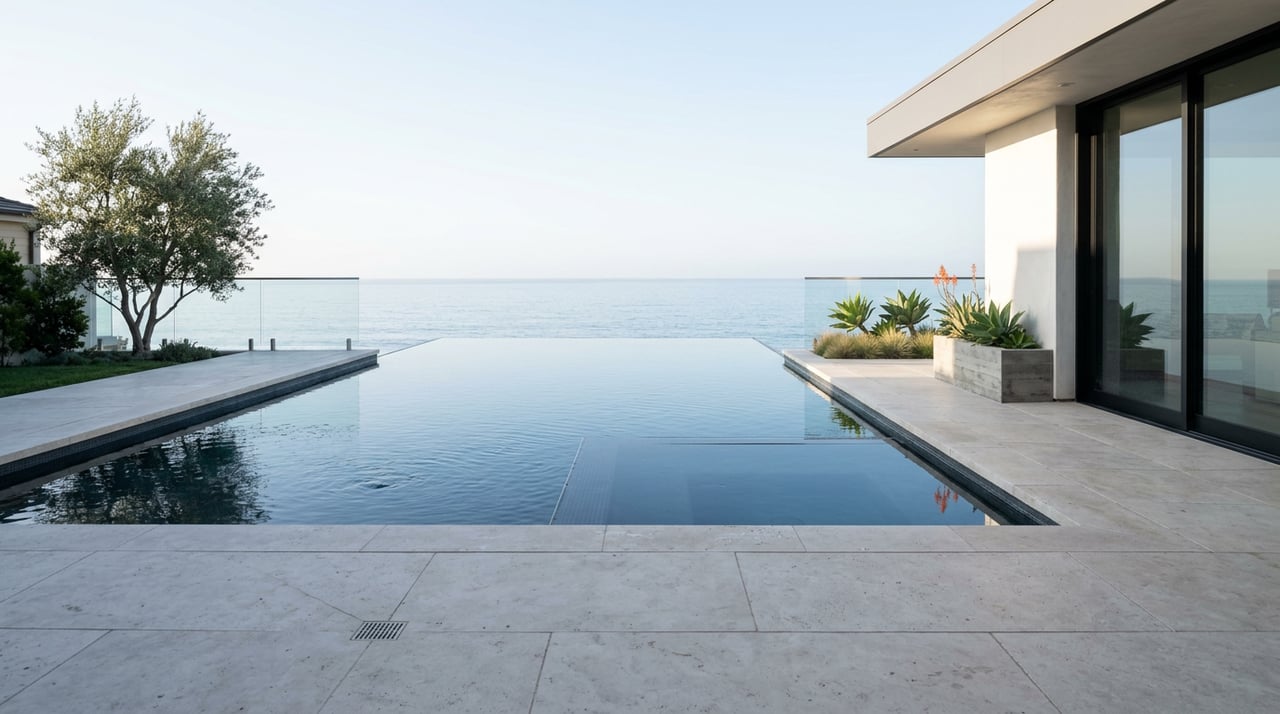
This is the highest-contrast pricing category in Carpinteria. Recent examples range from beach condos on Sandyland trading around $800,000 to $1.135 million to direct oceanfront Padaro Lane properties reaching roughly $16.95 million to about $26.925 million in a recent sale.
That spread shows an important truth about Carpinteria homes. “Beachfront” can mean very different things depending on lot, structure type, privacy, and direct relationship to the sand.
If you want coastal living with more daily convenience, the village core may be the best fit. The city describes Linden Avenue as the stem of the T-shaped downtown core and the hub of civic and commercial activity, with nearby residential areas mainly along Maple Avenue and south of Sawyer Avenue.
This part of Carpinteria offers a more walkable version of town life. The visitor center is in Linden Plaza on the 800 block of Linden Avenue, and the Amtrak site sits adjacent to the downtown commercial core, reinforcing the area’s role as the center of everyday movement and activity.
Village streets appeal to buyers who want to be near shops, dining, services, and the beach without being directly on the shoreline. It is often the part of Carpinteria that feels easiest to navigate on foot for errands and casual outings.
For buyers relocating from a denser urban area, this can offer a comfortable balance. You still get the coastal setting, but with a practical rhythm for daily life.
The tradeoff here is a busier environment. The city’s downtown parking study notes that Linden Avenue and Carpinteria Avenue rely on 90-minute limits in the most in-demand blocks, and some parking demand spills onto side streets during busier periods.
The city also notes that public parking in the downtown and beach areas is carefully managed, even though Carpinteria is one of only a few California beach communities with free public parking. For some buyers, that is a minor inconvenience. For others, it is an important quality-of-life factor.
Village and downtown properties are often more accessible than direct beachfront homes, though they are still clearly part of a premium coastal market. Realtor.com’s April 2026 snapshots show a median listing price of $1.1875 million in Downtown-Old Town Carpinteria and $1.175 million in Downtown Beach.
Recent single-family sales on village streets include 876 Elm Avenue at $1.698 million and 4727 7th Street at $1.725 million. For condo buyers, recent examples near Linden include a one-bedroom home at 231 Linden that sold for $800,000, a two-bedroom unit at 1118 Linden that sold for $810,000, and a three-bedroom unit at 1112 Linden that sold for $990,000.
If your idea of coastal living includes more separation, more privacy, and more of a view-oriented setting, the foothills may be worth a close look. Carpinteria’s elevation rises to about 700 feet, and the zoning map shows single-family residential districts along Foothill Road and other north-edge parcels.
This is where the town’s geography starts to change your experience more noticeably. You are typically farther from the beach core, but often in exchange for a different sense of space.
Foothill-style homes generally offer a quieter, more removed setting than the beach or village core. Based on the city’s geography and current Foothill Road listings, these properties often appeal to buyers who value privacy, larger parcels, and mountain or valley views more than walkability.
That can be especially attractive if you want a home that feels more tucked away while still keeping the coast within reach. In a small city like Carpinteria, that difference can feel significant.
This segment is highly parcel-dependent. Lot size, view orientation, privacy, and whether a property sits on a residential street or a larger estate parcel can all move values sharply.
Current Foothill Road listings show that range clearly, from a two-bedroom condo at $1.515 million to single-family homes around $3.716 million, $4.85 million, and $7.08 million, with one listing at $13.999 million. In other words, one foothill property may have very little in common with the next except the road name.
If you are trying to narrow your search, it helps to think in terms of lifestyle first and price second. In Carpinteria, those two are closely linked.
| Area | Best fit for | Main advantage | Main tradeoff | Typical pricing examples |
|---|---|---|---|---|
| Beachfront and beach-adjacent | Buyers prioritizing direct coastal access | Immediate beach lifestyle | Coastal hazard exposure and premium pricing | About $800,000 condos to $26.925 million estates |
| Village and downtown core | Buyers wanting walkability and convenience | Easy access to daily destinations | More activity and managed parking | Roughly $800,000 condos to mid-$1 million single-family homes |
| Foothills and north edge | Buyers seeking privacy and views | Separation, space, and elevated settings | Less walkability and highly variable pricing | About $1.515 million to $13.999 million in current examples |
While every listing is unique, a few broad budget bands can help frame your search. These are not fixed rules, but they are useful starting points based on recent examples in the market.
This price point tends to line up with smaller condos or older compact units, especially near the beach or village core. Examples include 231 Linden at $800,000 and 1118 Linden at $810,000.
This is often where much of the downtown-village inventory sits. It also captures the city’s Downtown Beach and Downtown-Old Town median listing prices, around $1.175 million to $1.1875 million, along with many renovated village homes in the mid-$1 million range.
This range is closely tied to foothill and view-home territory based on current Foothill Road listings. Here, property-specific details play a larger role in value.
This is the territory of direct oceanfront compounds and large estate parcels, especially on Padaro Lane. These homes sit in a different tier of the market and tend to trade based on a mix of rarity, shoreline position, and privacy.
The best area is not just about price. It is about how you want to live once you get there.
If you want sand-close living and immediate access to the shore, beachfront or beach-adjacent homes may deserve your focus. If your priority is a walkable, everyday coastal lifestyle, village streets and Linden-corridor condos may make more sense.
If privacy and views matter most, the foothills may be the strongest match. In a city as small as Carpinteria, the smartest search usually starts by defining your preferred rhythm of life, then comparing how each pocket of town supports it.
Carpinteria may be compact, but it offers a layered housing market with very different experiences packed into a small footprint. If you want help comparing coastal lifestyle options, evaluating value by micro-location, or narrowing your search with a clear strategy, Palmieri Stein Group is here to help you take the next step.
Stay up to date on the latest real estate trends.
Your real estate journey deserves a dedicated partner. At the Palmieri Stein Group, we deliver world-class service with a focus on personalized guidance, data-driven decisions, and luxury marketing.